
- At Least 22 Million Gallons of Sewage in the Bay
- Preventing Flooded Streets the Natural Way
- What Happens When High Tides Meet Toxic Sites?
- Protecting Seasonal Streams
- A Tribute to the Legacy of Delta Champion Bill Jennings
- Starting 2023 in a Big Way—Thanks to Our Supporters!
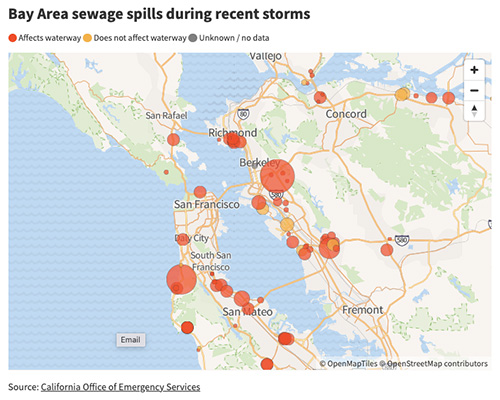
At Least 22 Million Gallons of Sewage in the Bay
As heavy rain overwhelmed Bay Area wastewater treatment systems these past two weeks, millions of gallons of untreated sewage overflowed into city streets, creeks, and San Francisco Bay. Current reports estimate at least 22 million gallons of raw sewage reached the Bay, but it’s likely more. As Baykeeper Director Sejal Choksi-Chugh explained to the San Francisco Examiner, the massive volume of overflows is a clear warning sign that the Bay Area’s sewage systems are woefully out of date:
“We can’t stop the rain from falling, and we want it to rain. So what we really need to do is look to see how our wastewater infrastructure has adapted. And unfortunately…they haven’t — they’re these decades-old systems that are falling apart, that have not had the investment and maintenance that they need.”
Preventing Flooded Streets the Natural Way
As rainwater flooded Bay Area streets the past two weeks, many of us witnessed first-hand that our existing stormwater pipes and city storm drains were unable to handle the large volumes of water.
But there’s a proven way to increase the ability of our streets to accommodate heavy rains, while also becoming more drought resilient. Green infrastructure uses natural elements, such as permeable pavement, sand and rock filters, and rain gardens. These elements absorb rain water, helping to refill our depleted groundwater supplies, instead of flooding and damaging our neighborhoods.
But the Bay Area has a long way to go. For example, the court compelled San Jose to overhaul its stormwater system because Baykeeper sued the city for polluting the Bay, and we won. However, their stormwater improvement plans include only a tiny investment in green infrastructure, and for only a tiny fraction of the city’s streets.
If the latest round of damaging storms has taught us anything, it’s that we need to provide incentives for cities to invest in green infrastructure right now.
What Happens When High Tides Meet Toxic Sites?
The Bay Area just saw flooding from heavy rains. But shortly, the Bay’s shoreline will be flooded by the rising sea as well.
When the gravitational pull of the Earth, Sun, and Moon line up, the force generates strong waves and high tides known as King Tides. The first round occurred in December, and now another round will take place on January 21 and 22.
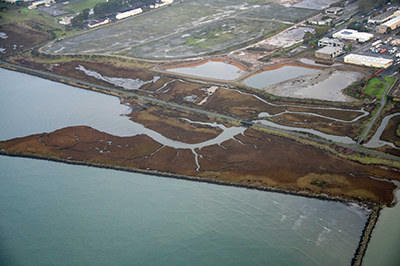
Baykeeper’s field team will be monitoring toxic shoreline sites that are vulnerable to flooding and could potentially release contaminants into the Bay. Working with our partners at Sierra Club, we’ll take detailed drone footage of toxic sites in Richmond, Marin City, Newark, and more. The footage will help us track which sites are most vulnerable to rising seas and flooding so that we can advocate for them to be prioritized for cleanup.
Pictured, above: Baykeeper drone footage of a toxic site in Richmond, formerly owned by the Astra Zeneca pharmaceutical company (and prior to that, the Stauffer chemical company), which lies next to Bay wetlands and is vulnerable to toxic flooding.
Protecting Seasonal Streams
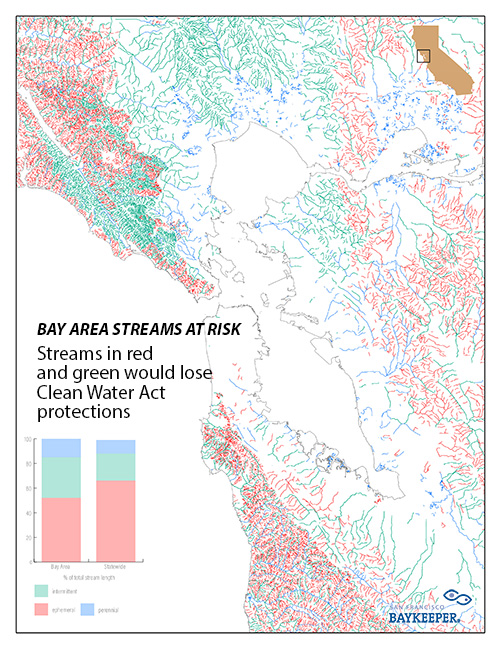
Many creeks, streams, and wetlands around the Bay are seasonal, swelling with water during the rains and disappearing entirely during dry spells—and sometimes even for years during a drought. More than two-thirds of the Bay’s tributaries are seasonal or intermittent. Baykeeper attorney Eric Buescher explained to ABC7 News that these waterways are essential to the overall health of the Bay ecosystem.
Unfortunately, the Supreme Court is considering a case this term that could withdraw federal Clean Water Act protections from seasonal creeks, streams, and wetlands. Our lawyers have filed a brief advising the court to protect seasonal streams around the Bay, and we’re also fighting for stronger laws at the local level. That way, California can strengthen its protections for seasonal waterways in anticipation of a bad court decision. While the waters in question may be intermittent, their effect on the Bay watershed is lasting.
Map, above: ephemeral and intermittent streams (in red and green) in the Bay Area, which are at risk of losing Clean Water Act protections

A Tribute to the Legacy of Delta Champion Bill Jennings
We recently lost one of the most passionate and effective advocates for the Delta’s waters and fishes. Bill Jennings, a lifelong environmental and civil rights activist, passed away in Stockton last month at the age of 79.
Bill served on our staff as Deltakeeper from 1995 to 2005. He spearheaded crucial environmental victories for the Bay’s watershed, including securing legal victories to stop mercury mine pollution, timber cutting operations, and concentrated animal farm pollution. Bill was Sejal Choksi-Chugh’s first boss when she joined Baykeeper in 2002, long before she became our executive director. Together, they succeeded in putting on the books the nation’s first regulations to control agricultural pesticides.
Sejal fondly remembers Bill as “a force of nature, with a hearty laugh that softened a true knack for speaking truth to power.”
In memory of Bill and his life’s work, the most fitting tribute Baykeeper can pay is to continue our work in the Central Valley with our partner organizations. We will continue advocating for long overdue water quality standards before we lose more of the species—like Delta smelt and salmon—that Bill devoted his life to protecting.
If you’d like to honor Bill’s memory, please consider making a gift to the California Sportfishing Protection Alliance, where Bill served as Executive Director
Starting 2023 in a Big Way—Thanks to Our Supporters!
2022 was a big year for Baykeeper. We responded to a historic algal bloom that killed thousands of Bay fish. We took legal action against a powerful oil refinery to stop toxic pet coke pollution in the Bay. We pushed Bay Area cities to clean up bacteria pollution that hurts water quality and wildlife. (To see more, check out Baykeeper’s 2022 Annual Report.)
And we’re not slowing down, because 2023’s already off to an eventful start.
During the heavy rains, our team has been in the field regularly to take stormwater samples so we can identify the polluters. We’re tracking sewage overflows from the Bay Area’s overwhelmed infrastructure. We’re also monitoring shoreline flooding, which will inform our advocacy to prepare for climate-driven sea level rise.
That’s why we’re so grateful to all the supporters who made a year-end gift to protect San Francisco Bay. Your generosity is what makes our critical work possible. From the entire Baykeeper team, we extend our heartfelt appreciation!
And if you haven’t yet made your gift to Baykeeper, consider making a beginning-of-year gift to keep us going strong!